The Thirty-Year Decision: A Facility Owner’s Guide to Getting Fixed Seating Right:
Why are the smartest seating choices made long before anyone sits down.
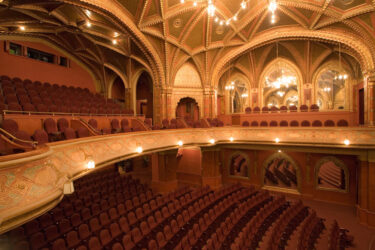
Walk into a well-run auditorium, theater, lecture hall, or arena and you probably won’t notice the seating at all. That’s the point. When fixed seating is specified well, installed correctly, and built to last, it disappears into the experience. People sit down, they’re comfortable, and their attention goes where it belongs — to the stage, the lecturer, the game, or the service. 
When seating is chosen poorly, the opposite happens. Squeaking mechanisms, sagging cushions, cramped rows, a wheelchair space stranded behind a column — those are the things audiences remember, and the things facility staff field complaints about for years.
What makes seating unusual among a facility owner’s decisions is its lifespan. It is one of the most heavily used and longest-lived components in the building. Quality auditorium seating, properly maintained, can serve for thirty years or more — the theater seating you install this year will still be in place when today’s kindergartners bring their own children to a performance. That is a remarkable return on a single decision, or a remarkably long time to live with a mistake.
This guide is written for the people who make that decision: architects, school administrators, university planners, facility managers, athletic directors, church leaders, performing arts directors, and the purchasing officials who sign off on it all. The aim is not to sell you a chair. It is to help you understand the process well enough to ask the right questions — and to bring the right people into the conversation early, while good decisions are still inexpensive to make.
Seating Is a Capital Investment, Not a Purchase
It helps to reframe the decision from the start. A facility owner outfitting a 300-seat church sanctuary or a 4,000-seat arena is not buying furniture. They are making a capital investment with a service life measured in decades, and the financial thinking should match.
That investment touches nearly every part of operations. Comfortable, durable auditorium chairs reduce complaints and maintenance calls. Well-planned row spacing protects your occupancy count and your revenue per event. And seating that lasts thirty years instead of twelve changes the entire economics of ownership.
This holds true whether you are responsible for lecture hall seating at a growing university, church seating for a congregation outgrowing its building, or stadium seating and arena seating that has to withstand weather, crowds, and decades of hard use. The venue changes; the principle does not. Seating is infrastructure, and infrastructure rewards planning.
Good Seating Starts With Good Design
The most expensive seating mistakes are rarely about the chair itself. They are about everything around it — the layout, the sightlines, the spacing, the way people move through the room. That is why auditorium design deserves attention long before anyone picks a fabric.
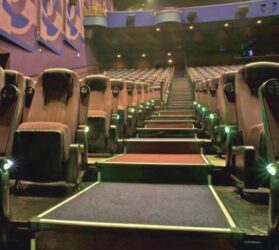
Consider sightlines. A seat is only as good as what you can see from it. The rake (the slope of the seating area), the row spacing, and the stagger between rows decide whether every guest has a clear view or whether the person in row K spends the night looking at the back of someone’s head — and these choices are difficult and costly to change once the concrete is poured.
Row spacing quietly drives the whole project, too. Tighter rows fit more seats, which sounds appealing until you weigh comfort, code-required egress, and the simple fact that cramped audiences do not come back. The right balance is a conversation worth having with a seating manufacturer who has solved it across hundreds of rooms.
This is the single most valuable thing a facility owner can do: bring seating expertise into the project during design, not after. An experienced seating partner brought in early can flag problems a general floor plan might miss and shape decisions while they are still inexpensive. Brought in late, that same expert can only tell you what it will cost to fix.
Know What You Are Actually Buying

Frame and gauge. The steel frame is the skeleton of the seat. Thinner-gauge steel costs less and fails sooner; heavier-gauge steel is the difference between a thirty-year seat and a ten-year one. Always ask what the frame is made of and how thick it is.
Foam density. Cushion comfort is not about how soft a seat feels in the showroom — it is about how it feels after five years of use. Foam is rated by density and by its ILD (Indentation Load Deflection), a number that describes how firm the foam is. Resilience — how quickly foam recovers — is a separate property. Low-density foam compresses fast and never recovers. Ask for the figures.
Fabric durability. Upholstery for assembly seating must be rated for commercial use, measured by a “rub count” (the Wyzenbeek or Martindale test). Commercial-grade theater seating fabric is typically rated at 100,000 double rubs or more. Residential fabric will not survive the traffic. More information regarding fabrics. Fabric choices.
You do not need to memorize these terms. You only need to ask for them — and to be wary of any seating manufacturer who cannot or will not hand over a full technical specification sheet. That reluctance tells you what you need to know.
ADA Seating Is Designed In, Never Bolted On
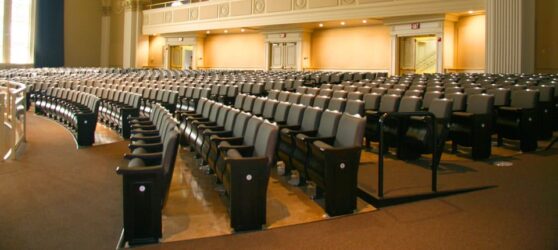
Accessibility is one of the areas where assumptions get expensive. ADA seating requirements for assembly facilities are specific, and they go well beyond counting wheelchair spaces. Federal standards govern how many accessible positions a venue needs, where those positions sit, how companion seats are arranged beside them, and — the requirement that surprises people most: how accessible seating is distributed across the room. You cannot cluster wheelchair spaces in the least desirable corner of the house. They have to be spread across price levels and sightline categories so that guests who use them get genuinely equivalent access.
The costly version of this story is familiar: a facility finishes installation, an inspector walks through, and the accessible seating is found non-compliant. Corrections then happen after the fact, at a fraction of the convenience and several times the cost.
The fix is to treat ADA seating as a design input, not a final check. Verify the count and the layout for your specific facility and jurisdiction before fabrication begins and confirm in writing who is responsible if the installed configuration does not pass. Compliance designed in is routine. Compliance retrofitted is painful.
Renovations Come With Surprises — Plan for Them
New construction is comparatively predictable. An auditorium renovation or theater renovation is where experience truly earns its keep, because existing buildings rarely match their own drawings.
Floors are not perfectly level. Riser depths may differ from the original plans. The condition of the concrete and the old anchor points stays unknown until demolition exposes it. Any of these can change how new fixed seating is anchored and aligned — and any of them can move cost and schedule if they surface mid-project instead of beforehand.
Take a common scenario. A theater renovation involves a house built in the 1970s, and the risers turn out to vary by a couple of inches across the room. Seating priced and engineered to the original drawings will not sit right. A seating contractor who runs a thorough field verification before fabrication catches that early and adjusts. One who prices off the drawings and hopes for the best hands you a change order after the trucks have already arrived.
The lesson for any renovation is simple: insist on a pre-fabrication site verification, and write a process into the contract for handling field conditions that differ from the plans. The surprises are normal. Being unprepared for them is optional.
Installation: Where Good Seating Succeeds or Fails
A beautifully engineered seat installed incorrectly is a liability, not an asset. Seating installation is its own discipline, and it is the stage where unclear responsibilities cause the most damage.
In too many projects, no one has clearly owned the installation. The seating manufacturer ships product. The general contractor assumes seating falls outside its scope. A specialty installer may or may not be involved. Then an anchor pulls loose or a row sits crooked, and three parties each make a reasonable case that it is someone else’s problem — while the facility’s opening slips and the lawyers get involved.
Avoiding that is a matter of clarity in writing. Who provides the installation labor? Who preps the substrate — the floor or riser the seats anchor into? Who inspects and accepts the finished work? Fixed auditorium seating, arena seating, and stadium seating all have to be anchored to the structure to meet code and load requirements, which often means shop drawings and, in renovations, stamped structural drawings from a licensed engineer. Those drawings carry a cost that is not always in the base price. Confirm it before you sign.
The reassuring part is that none of this is mysterious to a seating contractor who has done it hundreds of times. Experience is what turns installation from a risk into a non-event.
Lead Times and the Buffer Nobody Builds

The recurring mistake is scheduling with no margin: a performing arts center plans a summer installation ahead of a ticketed fall season, a steel delay pushes delivery a few weeks, and with no buffer and no contractual remedy, the venue eats the cost of rescheduling events that cannot simply be moved. Protect yourself on both fronts. Negotiate delivery dates with defined remedies for delays within the manufacturer’s control, and add a buffer — four weeks at the very least — between your contracted delivery date and your first real event. Buffer you never use costs nothing. Buffer you needed and did not have can cost a season.
Warranties, Maintenance, and the Long Life of a Seat
Every seating manufacturer offers a warranty. The useful question is what it actually covers once you read past the headline.
A “lifetime warranty” usually means the welded steel frame — and the frame is the part that almost never fails. Foam, fabric, finish, and the moving parts of any folding or reclining mechanism typically carry shorter, separate terms, or none at all. That is not necessarily a problem; you simply need to see the coverage broken out by component, in writing, before you commit.
Two more details shape decades of ownership. First, maintenance: most warranties are voided by cleaning products or methods the manufacturer has not approved, so learn the rules before your staff invents its own routine. Second, parts and repairability: a seat is only as supportable as its replacement parts. Ask whether components will still be available in ten or fifteen years, and how repairs are handled when a single seat in a row needs service. Seating that cannot be repaired economically is not a thirty-year seat, whatever the brochure claims.
Why the Lowest Bid Is Often the Most Expensive
Here is the counterintuitive math at the center of every seating decision: the cheapest proposal is frequently the costliest choice over the life of the seats.
Quality lecture hall seating, church seating, or theater seating that is properly specified, installed, and maintained can serve for thirty years. Seating that fails structurally at year ten, needs new foam at year seven, or develops mechanism problems no one can fix because the parts are discontinued has a far shorter life and a far higher total cost — even if it was fifteen percent cheaper to buy.
The better question is not “what does this cost to purchase?” It is “what does this cost to own over twenty or thirty years?” That figure includes maintenance, repairs, replacement parts, and the considerable expense of replacing seating early when it fails before its time. A seat that costs a little more and lasts decades almost always wins that comparison.
It is also worth watching what a low bid quietly leaves out. Freight, inside delivery, removal of old seating, concrete patching, aisle lighting, seat numbering, permit fees — each is legitimate, and each adds up. A bid that looks competitive on the first page can become the most expensive option once the excluded items reappear as invoices.
Choosing a Partner You’ll Still Trust in Year Fifteen
Because a seating relationship can last for decades, the company behind the product matters as much as the product. A warranty is only as solid as the manufacturer standing behind it, and a thirty-year promise from a firm that may not exist in fifteen years is not worth much.
This is where reference checking earns its place — done well, not generically. “Were you happy?” produces a useless answer. Specific questions produce real ones: Were there installation delays, and how were they handled? Did any change orders catch you off guard? How has the seating held up at the ten-year mark? When you filed a warranty claim, how quickly was it resolved? Would you choose this seating manufacturer again?
Ask for references from facilities like yours — similar type of a similar scale, installed within the last several years — and notice whether a company can produce them readily. Look for a partner who understands the entire arc of a project, from auditorium design and engineering through installation, maintenance, and the long years of ownership that follow. That breadth is what separates a vendor who sells chairs from a partner who delivers a result.
The Bottom Line: Plan Early, Ask Hard Questions, Build Once
Fixed seating is one of the few decisions a facility makes that it will live with for a generation. The auditorium seating, theater seating, lecture hall seating, church seating, and arena seating you install today will shape the experience of audiences, students, congregants, and fans long after the project itself is a memory.
The facilities that get it right share one habit: they start early and ask hard questions. They treat seating as part of the design conversation, not an afterthought to it. They verify ADA seating compliance instead of assuming it. They define installation responsibility in writing. They read the whole warranty, not the summary. And they weigh the cost of ownership, not just the number on the bid.
None of that requires you to become an engineer. It requires bringing the right expertise to the table at the right time — which is earlier than most people expect.
That is the role Preferred Seating is built to play. Whether you are planning an auditorium renovation, designing a new performing arts center, outfitting a lecture hall, expanding a church, or building an arena or stadium, the most valuable conversation you can have is the one that happens before the first seat is specified. If you are early in planning a project, that is exactly the right moment to talk — and Preferred Seating would welcome the questions. Facility Operators, click here for Checklist.