



Beam, Rail Mount vs. Floor Mount: Choosing the Best Stadium Seating Foundation
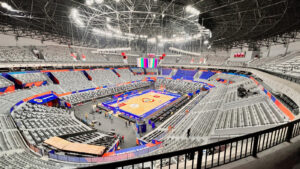 Walk into a modern stadium and you’ll see row after row of sleek chairs—a sea of comfort designed to keep fans cheering from kickoff to final buzzer. Yet the public rarely thinks about how those stadium chairs are anchored. Under every cup holder lurks a critical decision: beam mount (also known as rail mount) or floor mount? That choice shapes the entire seating plan, dictates long-term maintenance costs, and even influences future installation projects when the venue is renovated. Today, we’ll break down the terminology, weigh structural loads, and untangle the real-world pros and cons so you can decide which foundation is truly the better choice.
Understanding the Two Mounting Philosophies
What Exactly Is a Beam Mount?
 A beam mount stadium seating system, also known as rail mount, suspends multiple chairs on a shared steel or aluminum beam that’s anchored at intervals to the concrete slab. Think of it like a railroad track: the rail carries the collective load, while discrete uprights do the heavy lifting only at set points. Because the rail runs beneath the entire row, you gain continuous support without bolting every single seat into the floor.
Key takeaway: fewer anchor points mean quicker installation and less drilling into the slab, but beams must be engineered to handle cumulative weight and deflection.
How Does a Floor Mount Stadium Seat Differ?
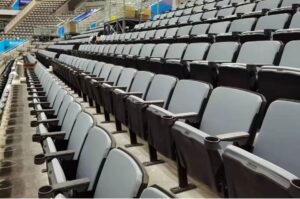 A floor-mount approach secures each seat—sometimes called a stanchion—directly to the concrete. Every chair gets its own anchor pattern, distributing weight across a forest of small columns rather than a continuous beam.
Key takeaway: floor-mount systems offer pinpoint stability for individual chairs, but they also require more anchors, more drilling, and more time in the field.
Terminology Cheat Sheet
| Term | Beam Mount Context | Floor Mount Context |
| Stanchion | End-support upright that holds the beam | Vertical post under each seat |
| Cantilever Load | Force applied away from support points on the rail | Minimal, because each seat bears its own load |
| Deflection | Beam sag between uprights | Not an issue; each post rests on its own anchor |
| Anchor Pattern | Two- or four-bolt plates under uprights | Two- to six-bolt plates under every seat |
Layout Flexibility: Designing for Fans Today and Tomorrow
Modularity and Seat Spacing
 When architects map out a stadium bowl, they juggle sightlines, egress codes, and ADA requirements. With beam mount rows, you can slide individual brackets along the beam before final tightening, giving you centimeter-level control over seat spacing. Need to widen an aisle or create premium seating pods next season? Simply reposition the chairs and loosen the bracket clamps, ensuring that the concrete does not have any new holes.
Why Rail Mounted Seating Is a Smart Move for Modern Venues
When it comes to optimizing installation and long-term flexibility, rail mounted seating is hard to beat. Whether you’re designing a new arena or upgrading a legacy facility, this system provides benefits that floor mount seats can’t always match. The secret? It starts with the installation process.
Two-Phase Installation, Full-Speed Progress
Rail mounted seating allows stanchions and rails to be installed during construction, keeping beam mount seats and accessories safely out of the way until other trades finish. This reduces damage risk and avoids delays. This is a practical win-win situation for both project managers and contractors
Flexibility Built Into Every Rail
Need adjustments? No problem. The rails allow lateral shifts of stanchions and customizable spacing of seat modules—enhancing comfort and closing unsightly gaps. Simply put, rail mounted seating means smarter planning, fewer headaches, and better results.
By contrast, floor-mount seats are literally set in stone. Adjusting the layout involves removing anchors, fixing the slab, and drilling new holes, which can be an unwieldy task during a tight off-season.
Radial vs. Straight Rows
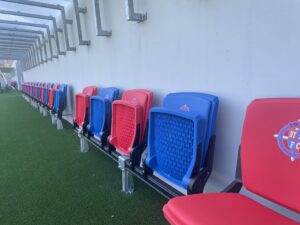 Most bowls curve. Beam mount systems can be pre-curved at the factory or segmented onsite, letting installers mirror that radius with fewer fittings. Floor-mount systems can follow a curve, but every stanchion must be rotated and aligned precisely—a time-consuming process that increases labor hours.
Futureproofing VIP Zones
Imagine a franchise upgrading nosebleeds to loge boxes in five years. With beams, crews unbolt entire stretches, integrate drink-rail modules, and reinstall. The original installation holes still line up. Floor-mount seats demand a jackhammer, dust containment, and new anchors—raising both budget and schedule risk.
Structural Load: The Engineering Reality Beneath the Logo
Point Loads vs. Distributed Loads
Floor mounting spreads weight evenly—each seat pipe transfers vertical force straight into the slab. Engineers like this predictability. However, because these anchors sit closer together, the concrete sees a constellation of small stress points that can crack if spacing or edge distance is off.
In a beam mount row, the beam behaves like a bridge girder. It takes vertical and torsional loads, transferring them to fewer anchor points that carry greater force. That means supports and welds must meet stricter specs. Done right, the slab sees fewer penetrations and lower aggregate stress, but any mis-calculations in beam gauge can lead to noticeable bounce when fans leap to their feet.
Material Thickness and Corrosion
To handle bigger spans, a beam mount often uses thicker-gauge steel or reinforced aluminum. Hot-dip galvanizing and powder coatings protect these beams, yet inspectors must monitor weld seams where rust likes to hide. Floor-mount posts are shorter and easier to galvanize inside and out, but because there are so many, surface damage during installation is common—each scratch is a future rust bloom.
Dynamic Crowd Loading
Let’s picture a playoff game. Ten thousand fans stomp in unison. The rhythmic load is called “dynamic crowd forcing.” Rails act as dampers, absorbing wave energy across the row. Floor-mount seating transfers vibration seat by seat, which can amplify localized fatigue in anchor bolts. The engineering team must model peak crowd choreography and design accordingly.
Maintenance: Counting the Cost After Opening Day
Inspecting Hardware
Every venue runs annual torque checks. With beam mount systems, you might tighten 300 uprights in an arena bowl. With floor mounts, the count balloons to 900 or more. Multiply by twenties of bowls nationwide, and labor hours skyrocket.
Cleaning and Debris
Under-seat popcorn and soda wreak havoc. A beam row has a clear span below the seat pan, so custodians pass vacuums quickly. Floor-mount stanchions create mini dead zones—junk collects around each post, inviting pests and mold. Clean floors mean happy health inspectors.
Replacing Damaged Seats
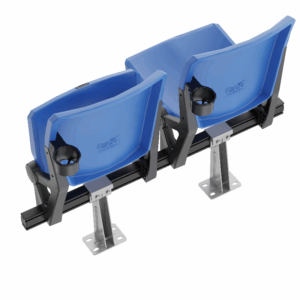 Accidents happen: a mascot swings a t-shirt cannon too wide; a bolt shears. On a beam, swap out the bracket, slide on a new shell, and call it a day. Floor mounts force you to unbolt the individual stanchion—often ruining the anchor epoxy in the process. That’s extra epoxy, cure time, and downtime.
Budget Math and Life-Cycle Economics
Upfront Capital
A beam mount kit appears pricier—heavier steel, custom fabrication, and specialized freight. Meanwhile, floor-mount seats are commodity parts. But labor can flip the script. Crews report 15–25% faster row installation with beams because there are fewer anchors and alignment jigs.
Long-Term Savings
Maintenance managers love numbers. Over a 30-year life, many beam mount venues document 40% fewer bolt replacements and a 20% reduction in concrete patch work. Add the fact that layout-change flexibility saves six-figure sums during remodels, and beams often win the total-cost-of-ownership game.
Case Study Snapshot
- Riverfront Arena (2020 build): opted for beams, reconfigured premium rows after just two seasons; ROI on up-front beam cost realized in year three.
- MetroDome Upgrade (2018 retrofit): kept floor-mount pattern; unplanned ADA revisions cost an extra $750,000 in slab repair.
Sustainability and Carbon Footprint
Architects chasing LEED points scrutinize embedded carbon. Beams use more steel per row, which seems bad—yet fewer anchors mean less chemical epoxy and less power-tool runtime during installation. A life-cycle assessment for one MLS venue showed equivalent CO₂ emissions after ten years because beam refurbishments required far fewer replacement parts. In the long arc of a stadium, longevity beats initial tonnage.
Decision Matrix: Finding Your Perfect Fit
| Criterion | Beam Mount Score (1–5) | Floor Mount Score (1–5) |
| Layout Flexibility | 5 | 2 |
| Structural Simplicity | 3 | 5 |
| Maintenance Labor | 4 | 2 |
| Upfront Cost | 3 | 5 |
| Future Upgrades | 5 | 2 |
| Cleaning Efficiency | 4 | 2 |
| Total | 24 | 18 |
Interpretation: If your team values adaptability and long-term operating savings, the beam mount usually comes out ahead. If your priority is the lowest first-cost on a static bowl, floor mount could still make sense.
A Final Word from the Stands
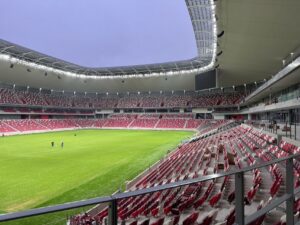 Choosing between beam mount and floor mount isn’t just an engineering call—it’s a brand decision. Fans rarely notice bolt patterns, but they do feel the bounce of a flimsy seat or gripe when a remodel shuts their section all summer. By investing in the right foundation today, you ensure your stadium seating stays safe, comfortable, and camera-ready for decades.
So, next time you’re touring a new build or planning an upgrade, peer beneath those shiny seat pans. Ask about beam gauges, anchor counts, and maintenance logs. Whether you’re an architect, a facility manager, or a die-hard supporter curious about where your season-ticket dollars go, knowing the difference can make you a smarter stakeholder.
The playbook you have prepared is straightforward: assess layout flexibility, structural load dynamics, and maintenance reality. Add cost projections, sprinkle in sustainability metrics, and decide which system aligns with your mission. If adaptability and long-term value rank high, the beam mount is often the champion. If rock-solid simplicity at the lowest initial price trumps all, floor mount can still bring home the win.
Either way, remember—great stadium seating isn’t what fans notice; it’s what they forget. Because when every chair feels rock solid, the only thing on their minds is the scoreboard. Nothing else matters. The stadium hums with energy, and the focus stays where it belongs—on the game.


Veo 3 AI
3 Jul 2025The emphasis on modularity and different venue types really speaks to the evolving needs of event spaces—especially with the growth of hybrid-use facilities. It’s interesting to see how seating design is adapting to support both function and flexibility.
Veo 3 AI
4 Jul 2025It’s interesting to see how seating design plays such a crucial role in the overall architectural layout of a venue. Especially for multipurpose spaces, finding that balance between flexibility and long-term durability must be a key challenge.
Veo 3 AI
5 Jul 2025I really appreciate the focus on custom designs for venues. Having seats that not only look great but are also functional for different events is crucial for a long-lasting, versatile space.
Veo 3 AI
6 Jul 2025I appreciate how you’ve covered seating options for such a wide range of venues. I’m curious—what are some key considerations when choosing between beam floor mount and rail-mounted seats for a multipurpose facility?
Veo 3 AI
7 Jul 2025Great overview of the different venue-specific seating needs. Balancing durability and style is always a challenge, especially in high-traffic spaces like lecture halls or arenas—it’s good to see solutions that seem to consider both.
Veo 3 AI
8 Jul 2025Interesting to see how beam seating can be integrated into multipurpose venues so seamlessly. It’s a good reminder that flexible seating doesn’t have to compromise on durability or aesthetics.
Veo 3 AI
9 Jul 2025I hadn’t realized how much seating design can impact the versatility of a venue. The beam-mounted options seem like a smart choice for multipurpose spaces where flexibility is key.
Veo 3 AI
10 Jul 2025I appreciate how this post breaks down the variety of seating options based on venue type—it’s helpful to see everything from church seating to stadium installations all in one place. I’m particularly interested in how beam floor mount and rail-mounted systems compare in terms of long-term maintenance and flexibility for multi-use spaces. Are there certain environments where one significantly outperforms the other?
Veo 3 AI
11 Jul 2025It’s great to see a clear breakdown of seating options tailored to differentBlog Comment Creation venue types—from lecture halls to multipurpose spaces. The inclusion of both fixed and portable beam seating is especially helpful for planners looking for flexibility without compromising on design cohesion.
Veo 3 AI
12 Jul 2025It’s great to see such a wide variety of seating options for different venues. I especially appreciate how the designs can be tailored to specific venue types like theaters or multipurpose spaces. Customization really seems key for creating the best environment for the audience.