


Maximizing Ministry: The Rise of Multipurpose Facility Design in Church Architecture
 Imagine walking into a church foyer on a Thursday night and finding it bustling with community activity—a senior group meeting by the fireside, a children’s choir practicing behind an operable wall, and a youth sports team wrapping up drills in the worship space. Welcome to the modern church: a place not just of Sunday sermons, but seven-day-a-week service.
The concept that’s fueling this transformation? A popular trend among professionals is the development of multipurpose facility design, also known as multi–ministry spaces. Though it’s been around for decades, this church design philosophy is evolving fast, and it’s reshaping the way church leaders think about space, stewardship, and service.
Why Multi-Ministry Spaces Are More Than a Trend
Churches aren’t just buildings. They’re lifelines for the communities they serve. But let’s face it—church construction is expensive, and so is maintaining unused space. That’s where multipurpose facility design comes in. Instead of single-purpose rooms that sit idle much of the week, churches are turning to flexible, multi-purpose environments to maximize both space and mission.
In many communities, especially where budgets are tight, building expansive complexes with dedicated rooms for every ministry just isn’t realistic. A church building that can transform from sanctuary to classroom, from fellowship hall to performance venue, ensures every square foot works harder—every day of the week.
It’s not just financially savvy. It’s good stewardship. And it’s helping churches stay relevant and accessible in a time when physical attendance is challenged by digital engagement and shifting schedules.
Design Smart: The Nuts and Bolts of Multipurpose Facility Planning
 Flexibility doesn’t happen by accident. It starts with intentional church design—the architectural foundation that makes transformation possible.
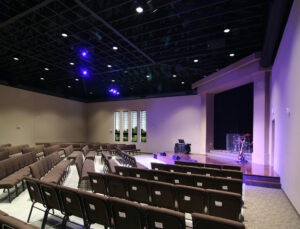
Let’s talk layout. A worship space with a flat floor and portable multipurpose seating can serve as a sanctuary on Sunday, a dining hall on Wednesday, and a conference center or basketball court on Friday. Compare that to a space with sloped or stepped flooring—it may look majestic but limits reusability.
Platforms with built-in AV systems, movable risers, and professional-grade lighting open doors to theatrical performances and concerts. Even smaller touches, like foldable partitions or stackable chairs, make an enormous difference in how the worship seating space can adapt.
Take into account the United Methodist Church in Illinois. Their church building features a 500-seat worship space with all the flexibility mentioned above. It doesn’t just host worship—it welcomes youth athletics, banquets, and dramatic productions, all under one roof. That’s the power of well-executed multi-ministry space planning.
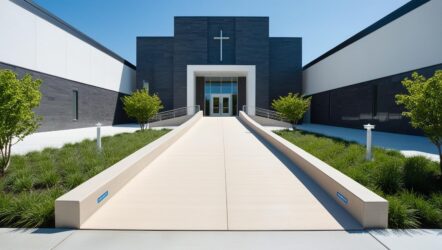
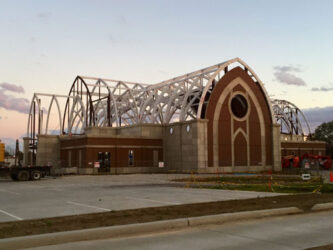
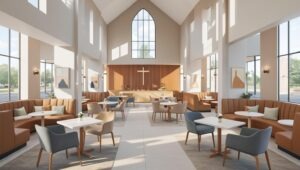
The images found in this article highlight the following designs:
- Multipurpose seating & flat floors – Perfect for transitioning between worship, banquets, conferences, or youth sports.
- Integrated lighting & sound systems – Supports theatrical performances, musical events, and presentations.
- Minimal fixed architecture – Open designs that easily adapt to different layouts and crowd sizes.
- Multipurpose stage setups – Ideal for speakers, musicians, or graduations, making them true multi-ministry spaces.
Beyond the Sanctuary: Rethinking the Entire Church Building
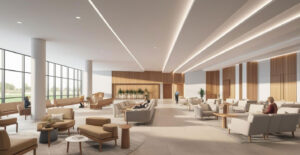 While most people picture pews and pulpits when they hear “church,” forward-thinking church design looks beyond the sanctuary. Why not make every room ministry-ready?
Take the church foyer—once just a transitional space between parking lot and pew. Today, it’s prime real estate. Bellview Church merged their children’s ministry with the foyer using an operable wall system. When it’s time for kids’ worship, the wall closes. When it’s not, the space opens up for coffee hours, receptions, or informal gatherings.
Hockings Church of Christ took it a step further. Their foyer includes a cozy fireside room that doubles as a senior adult classroom. Again, with an operable wall, this flexible church building space expands for large events without sacrificing intimacy during the week.
Multi-use facility design extends to chapels, classrooms, even hallways. Children’s worship areas now double as wedding chapels. Adult education spaces become weekday daycare rooms. There’s no such thing as dead space anymore—only opportunity.
Overcoming the Limitations: What Can’t Be Changed (And What Can)
Of course, not every church construction detail is adaptable. Large sanctuaries with sloped flooring struggle to accommodate tables for dining or training. And flat-floor spaces, while flexible, max out around 1,200 people before sightlines suffer.
But that doesn’t mean multi-use is off the table. It just means church leaders must be strategic. Prioritize versatile areas. Focus renovation dollars on the foyer, classrooms, or smaller chapels where flexibility yields higher weekly usage.
Remember: multi-ministry spaces are about more than just walls and floors. They’re about mindset. It’s the idea that every room can serve more than one purpose, and every purpose can serve more people.
The Stewardship Advantage: Doing More with Less
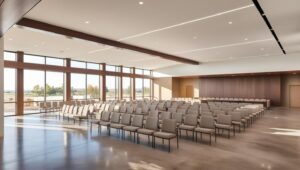 If you’ve been involved in church construction, you know how fast costs rise. Labor, materials, even permits—they all stack up. Is there a reason to construct three rooms when one can accommodate three functions?
By leaning into multi-use facility design, churches demonstrate wise financial stewardship. This not only stretches the budget but strengthens the church’s witness as a responsible and forward-thinking institution.
Churches that embrace multi-ministry spaces don’t just save money—they create life. Spaces that once sat dark from Monday to Saturday now pulse with activity: parenting groups, youth leagues, small business seminars, arts nights. All happening under the same roof, using the same AV system and seating.
This isn’t about cutting corners. It’s about opening doors.
Final Thoughts: The Church That Never Sleeps
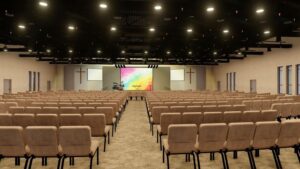 In a world where efficiency and outreach are equally essential, multipurpose facility design is more than a trend—it’s a blueprint for the future. Churches that think creatively about their worship space, their church building, and how each room can serve multiple ministries are better equipped to thrive in an ever-changing cultural landscape.
Let’s move beyond the Sunday-only mindset. Let’s design churches that welcome the community every day—whether they come to worship, learn, celebrate, or serve. Contact Preferred Seating for a free consultation in church seating design.
After all, if the Church is the people, then the building should be where the people are.